Heartspring News
Heartspring Unveils Rendering for Kansas’ First Standalone Center for Pediatric Neurodevelopment — Integrating Multi-Clinic Outpatient Care, Applied Research and Clinical Training
Expansion advances specialized, integrated care for children with neurodevelopmental disorders and disabilities; academic collaboration with KU School of Medicine-Wichita and Wichita State University anchors clinical training and applied research.
Contact Information
Jamie Mullen-Hearn, Marketing & Communications Director
Phone: 316-370-1466
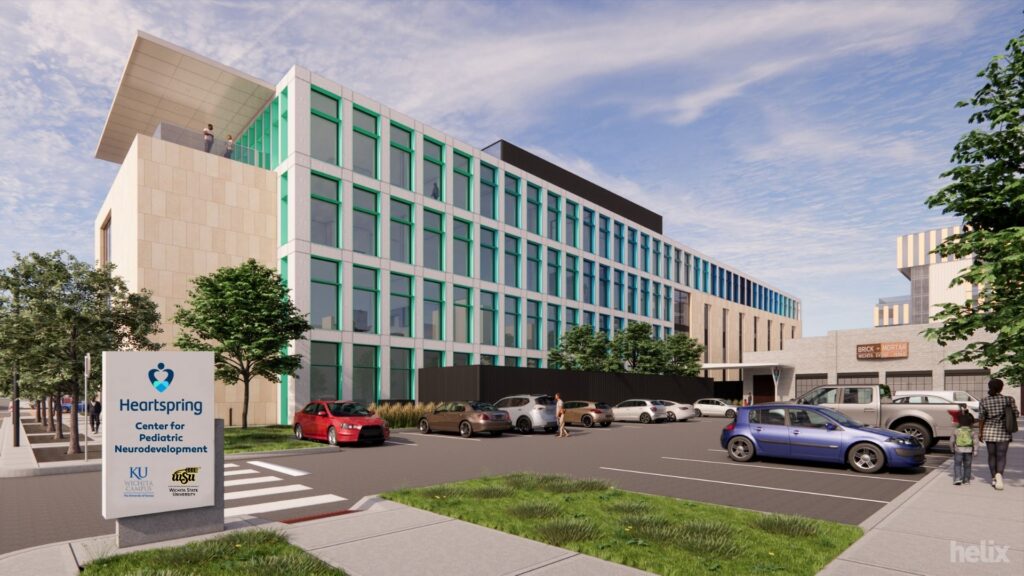
WICHITA, Kan., March 30, 2026 — Heartspring today unveiled an architectural rendering for its future standalone multi-clinic outpatient center — the first facility of its kind in Kansas dedicated exclusively to children with neurodevelopmental disorders, disabilities, and complex conditions. Located in Wichita’s Healthcare Corridor across from the Wichita Biomedical Campus℠, the center will integrate specialized clinical care, clinical training, and applied research under one roof. Building on Heartspring’s existing model of integrated, interdisciplinary care, the expansion creates a learning environment where clinical practice and innovation advance together, each informing the other. The rendering marks a significant milestone in Heartspring’s expansion, moving from vision and land acquisition to a clearer picture of what Kansas families will be able to access.
“Across our region, the need for interdisciplinary pediatric neurodevelopment care is outpacing systems that were never designed to meet this level of complexity,” said Dan Soliday, President & CEO of Heartspring. “For families, that often means navigating fragmented care — even going out-of-state — when they need clarity and support the most. We believe there is a better way to do this and a responsibility to build it. Heartspring’s expansion is an opportunity to move beyond fragmented approaches and define a more integrated model of care that responds to how children and families experience need. Heartspring is stepping into a role where we can help shape what that model looks like for Kansas and, over time, for the broader field of pediatric neurodevelopment.”
Today, one in six U.S. children aged 3–17 has a diagnosed developmental disability, and families nationwide face lengthy waitlists, limited access points, and increasing care complexity. In Kansas, demand for pediatric neurodevelopment services consistently outpaces what the system can provide, and Heartspring feels that pressure every day.
The new rendering from Helix Architecture + Design reflects the scale and intent of Heartspring’s expansion. The facility is designed not only to serve more children, but to advance the field. By embedding applied research alongside clinical practice, insights from direct patient care can be translated into improved treatment approaches, shared with the broader field of pediatric neurodevelopment, and brought back to benefit the children Heartspring serves. With this growth, Heartspring anticipates creating 60–70 new high‑skill jobs across clinical care, research, and education, and tripling its outpatient capacity to assess, diagnose, and treat children with neurodevelopmental needs.
That growth translates directly to families. Shorter waitlists and earlier access to diagnostic and therapeutic services mean greater stability for families. Timely care and early intervention enable parents to maintain employment, siblings to receive more consistent support, and long‑term public costs to decrease. Heartspring currently contributes $26–36 million annually to the Kansas economy and employs more than 400 Kansans. Post-expansion, that economic impact is projected to grow to $44–54 million annually.
Heartspring’s downtown facilities, purchased in 2024, will undergo renovation and construction in the coming years, with occupancy anticipated in 2030. The expansion also includes renovation of its East Wichita campus, currently home to both its Pediatric Outpatient Clinic and Therapeutic Residential & Day School. When the downtown center opens, the East Wichita campus will continue to offer some outpatient services and remain the home of Heartspring’s school. In the school, therapies are woven directly into the educational and residential environment so that every child benefits from the interdisciplinary approach. Applied learning will continue to thrive on the East Wichita campus as well, and advances in care developed through applied research will strengthen outcomes for every child Heartspring serves, across both locations.
Wichita State University already maintains a clinical presence on the East Wichita campus. The University of Kansas School of Medicine-Wichita and Wichita State will have a significant clinical presence within Heartspring’s new downtown facility, embedding academic partnership more deeply into the care environment. This integration deepens workforce development pathways, strengthens training for the next generation of clinicians, and supports a more connected statewide system of care. The proximity of academic partners within the facility also creates a direct pipeline between clinical practice and research, accelerating the kind of applied innovation that can improve outcomes not only in Kansas, but across the field.
“Today’s announcement marks a meaningful return to our shared roots,” said Dr. Greg Hand, dean of Wichita State’s College of Health Professions. “Heartspring began as the speech‑language clinic for Wichita State University’s College of Health Professions, and in many ways, we are coming full circle as we deepen our clinical and educational partnership. As Heartspring works to establish itself as a center of excellence in pediatric neurodevelopment, WSU’s College of Health Professions continues advancing its own vision to become a regional hub for pediatric care and pediatric healthcare education. Together, we are aligning to meet an urgent need for integrated, interdisciplinary care for children and families across Kansas.”
Laura Tatpati, M.D., professor and dean, KU School of Medicine-Wichita, highlighted what that partnership means for the future of medicine in Kansas.
“Partnerships like this help Kansas attract and retain the clinicians who will define the future of medicine,” said Tatpati. “Training the next generation of clinicians requires environments where complexity, collaboration, and community impact are built into the model. Heartspring’s expansion creates a shared vision where academic medicine and community care come together for Kansas families.”
More than 500 Kansas children turn to Heartspring each year for developmental evaluations, interdisciplinary therapies, and specialized residential education. With statewide autism diagnoses increasing more than threefold since 2005 and the rising prevalence of developmental disabilities across the region, the families who will benefit from this expansion often wait months, or even years, for services today.
“Kansas families need integrated neurodevelopment care now, not years from now,” said Heather Hogan, Heartspring’s Chief Advancement & Strategy Officer and Legacy Foundation President. “Meeting that need requires more than expansion alone. It requires building the capacity, workforce, and partnerships that make access sustainable over time. This work is about ensuring families can rely on a system that is designed to support them today and into the future.”
This weekend, Rouge: The Heartspring Gala will offer the community its first public look at the new rendering, bringing together civic leaders, healthcare and academic partners, philanthropists, and regional stakeholders to celebrate this milestone and join Heartspring in building what comes next for Kansas families and the broader field of pediatric neurodevelopment.
###
About Heartspring
Heartspring is a place of possibility for children the world underestimates. Based in Wichita, Kansas, Heartspring assesses, diagnoses, treats, educates and inspires children with neurodevelopmental disorders, disabilities, and complex conditions — a population that requires specialized, integrated care that most systems are not designed to provide.
Founded in 1934 as the Institute of Logopedics, Heartspring has a 92-year legacy of delivering evidence-based therapies and education for children with neurodevelopmental conditions. Its Pediatric Outpatient Clinic and Residential Program within its Therapeutic Residential & Day School earned a three-year accreditation from CARF International in August 2024. The organization is expanding with a new state-of-the-art, multi-clinic care, applied research and learning center in Wichita’s downtown healthcare corridor, across from the Wichita Biomedical CampusSM.
Learn more at www.heartspring.org.
Published: Mar. 24, 2026
Share this